

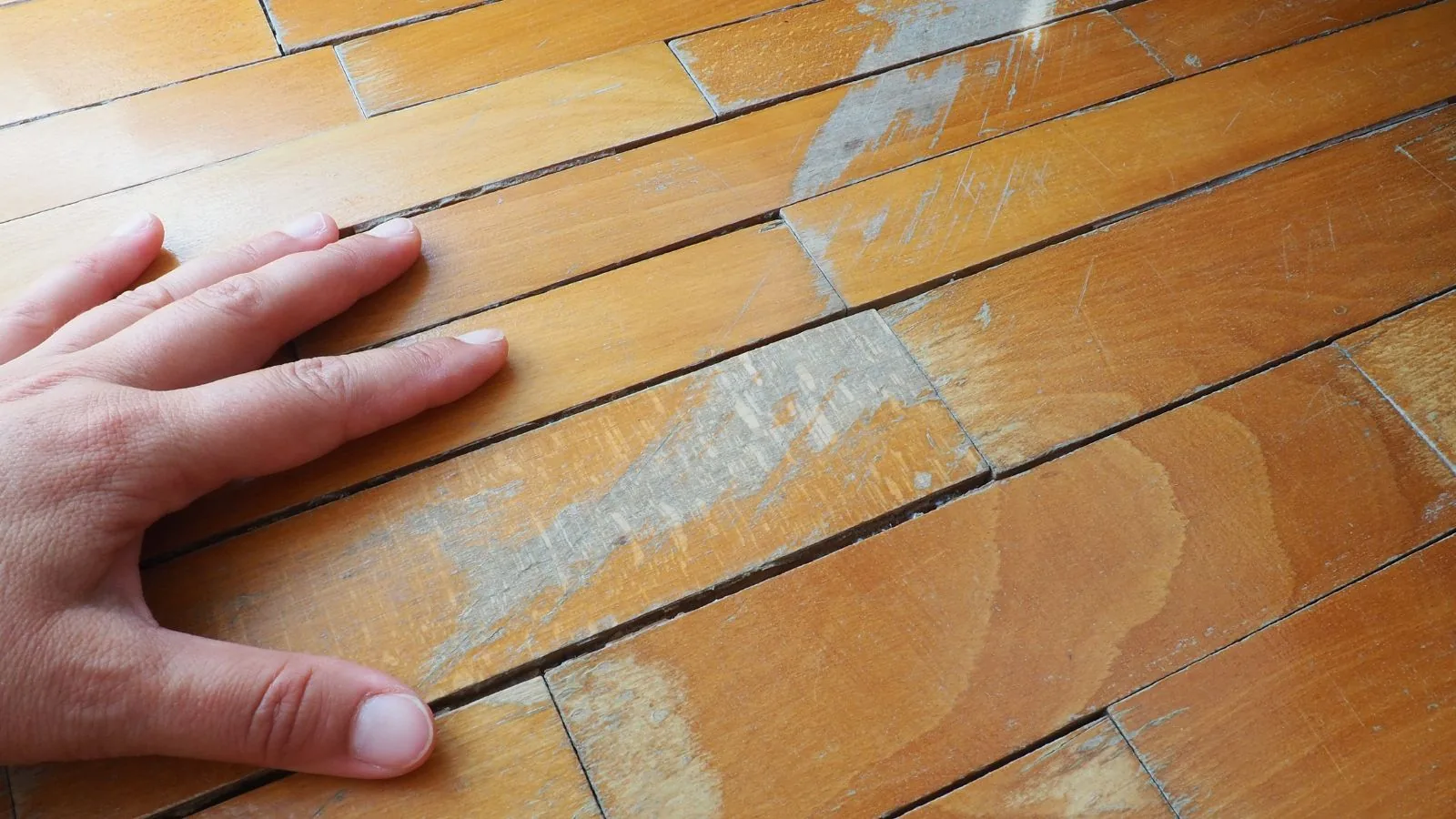
What water does to a hardwood floor
Hardwood floor water damage is the cupping, crowning, buckling and staining that appears when wood absorbs water from a leak, a flood or high humidity. Wood takes up moisture through the edges and the underside first, so the damage often starts below the finish where you cannot see it.
Cupping, where board edges rise higher than the middle, is the usual first sign. Crowning is the opposite and tends to appear after cupped boards are sanded too early. Buckling, where boards lift off the subfloor, means the damage is severe.
First steps to protect a wet wood floor
- Stop the water source and mop up standing water right away.
- Lift rugs, furniture and anything that holds moisture against the floor.
- Do not use heat guns, space heaters or a flat iron to speed drying. Fast drying can split boards.
- Keep air moving gently and avoid sealing the room tight until readings are taken.
- Photograph the floor and call us before sanding or refinishing anything.
Drying wood without ruining it
Wood needs slow, controlled drying. We take moisture readings across the floor and in the subfloor, then place air movers and dehumidifiers to dry from above and, when needed, from below through small openings. Specialty drying mats can pull moisture up through the boards.
A floor is not judged right after it dries. Boards often settle over days or weeks, and some cupping relaxes on its own. We re-measure before anyone recommends sanding. If the damage came from a slab or a basement, our slab leak page explains how water gets up into finished floors.
Save, refinish or replace
If the boards are flat and the readings are back to normal, a sand and refinish may be all that is needed. If boards are permanently cupped or the finish has delaminated, replacing the affected area may be better than trying to rescue it. Water that carried contamination, such as flood water, usually means replacement for soaked boards.
Marshfield's median owner-occupied home value is $621,300 in the 2019 to 2023 Census QuickFacts, and original hardwood is often a feature worth preserving where the boards can be dried properly. That is a reason to get readings before deciding.
Engineered, solid and floating floors react differently
Solid hardwood is thick enough to be sanded several times and can often handle a slow dry. Engineered flooring has a thin wear layer over plywood layers, so it may delaminate or peel when soaked. Floating laminate swells at the edges and rarely returns.
Tell us what you have. If you are not sure, a board edge or a floor vent opening often shows the layers. That detail shapes the drying plan and the advice we give about repair.
Subfloors and finishes underneath
Wood floors often sit on plywood or boards, with felt or rosin paper between. Water can pool in that layer long after the surface looks fine. We use probes to read through the boards, and in some cases remove a few boards to let air in.
Finishes matter too. A surface finish can trap moisture inside the wood. We avoid sanding until readings settle.
Why drying follows a standard
The ANSI/IICRC S500 standard is the industry reference for drying wet structures, and it treats dense materials like hardwood as the slowest to dry. That is why we log readings across several visits instead of promising a quick finish.
Insurance and what to document
Sudden and accidental water damage to flooring is often covered, while slow leaks and seepage often are not. Check your policy and ask your insurer. Take photos of the floor before and after drying, and keep moisture readings if you receive them.
If a pipe or appliance caused the damage, see burst pipe water damage or kitchen water damage for how the source is handled.
Questions homeowners ask
Can a cupped hardwood floor be fixed?
Often yes if it is dried slowly and the boards have not split. Many floors flatten as moisture levels return to normal, and sanding is delayed until readings stabilize.
How long should I wait before sanding?
Until moisture readings are back to normal and boards stop moving. Sanding too early can cause crowning.
Is hardwood damage from a flood salvageable?
Rarely if the water was contaminated. Floodwater is treated as Category 3 and soaked wood is usually replaced.
Can I use a fan and heater to dry the floor?
Gentle airflow is fine. Heat can split boards and make damage worse.
Still have a question about hardwood floor water damage? Call (781) 621-1785 and ask us directly.